How to Calculate Cubic Yards: Formula & Examples
How to Calculate Cubic Yards: Formula, Examples & Material Guide
Calculating cubic yards is useful whenever you need to estimate the amount of a bulk material required for a project. Concrete, gravel, mulch, topsoil, sand, fill dirt and many other materials are commonly measured or sold by the cubic yard.
The good news is that the basic calculation is simple.
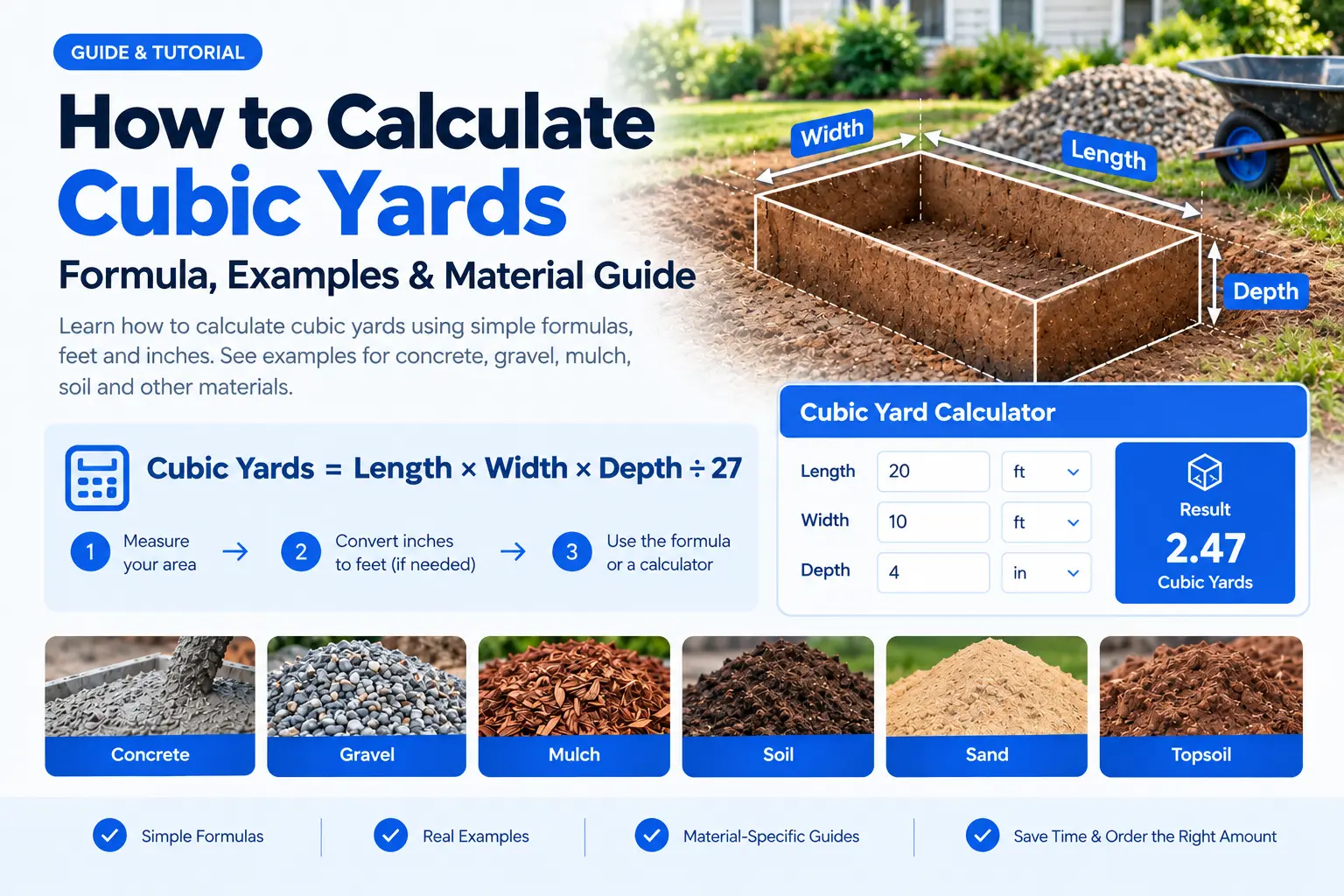
For a rectangular area, multiply the length × width × depth to find cubic feet, then divide by 27 to convert cubic feet into cubic yards.
Cubic Yards = Length × Width × Depth ÷ 27
The tricky part is usually making sure all measurements use compatible units—especially when your length and width are in feet but your depth is in inches.
In this guide, you’ll learn how to calculate cubic yards step by step, convert inches correctly, understand the 27-cubic-foot rule, calculate material for concrete, gravel, mulch and soil, and avoid common mistakes.
If you already have your measurements, you can use the BotCrumbs Cubic Yard Calculator to calculate the result automatically.
What Is a Cubic Yard?
A cubic yard is a unit of volume.
Imagine a box that measures:
- 3 feet long
- 3 feet wide
- 3 feet high
That box contains exactly one cubic yard.
Because:
3 × 3 × 3 = 27 cubic feet
Therefore:
1 cubic yard = 27 cubic feet
This is the most important conversion to remember when calculating cubic yards.
Cubic yards are commonly used for bulk materials such as:
- Concrete
- Gravel
- Sand
- Mulch
- Topsoil
- Fill dirt
- Compost
- Landscaping materials
The reason cubic yards are useful is that these materials are often purchased in relatively large quantities rather than by individual pieces.
How Do You Calculate Cubic Yards?
For a rectangular area, the basic formula is:
Cubic Yards = Length × Width × Depth ÷ 27
However, there is one important rule:
All three measurements need to be converted to the same unit before you multiply them.
For example, suppose you have an area that is:
- 20 feet long
- 10 feet wide
- 4 inches deep
You should not multiply 20 × 10 × 4 directly.
The 4-inch depth needs to be converted into feet first.
Step 1: Convert inches to feet
There are 12 inches in one foot.
So:
4 ÷ 12 = 0.3333 feet
Step 2: Calculate cubic feet
Now multiply:
20 × 10 × 0.3333 = 66.67 cubic feet
Step 3: Convert cubic feet to cubic yards
Divide by 27:
66.67 ÷ 27 = 2.47 cubic yards
So the project requires approximately:
2.47 cubic yards
For a quick calculation using your own measurements, use the [Cubic Yard Calculator] on BotCrumbs.
The Cubic Yard Formula
The standard rectangular-volume formula is:
Volume = Length × Width × Depth
When the dimensions are measured in feet:
Cubic Feet = Length × Width × Depth
Then:
Cubic Yards = Cubic Feet ÷ 27
Combining those two steps gives:
Cubic Yards = Length × Width × Depth ÷ 27
This formula works for rectangular areas such as:
- Garden beds
- Mulch areas
- Gravel areas
- Concrete slabs
- Sand beds
- Excavation areas
- Fill areas
The important thing is that the dimensions must be converted into compatible units before calculating the volume.
How to Calculate Cubic Yards When Depth Is in Inches
This is one of the most common situations when calculating landscaping or construction materials.
For example, you might measure an area in feet but specify the material depth as:
- 2 inches
- 3 inches
- 4 inches
- 6 inches
- 8 inches
- 12 inches
Because 12 inches equals one foot, convert the depth using:
Depth in feet = Depth in inches ÷ 12
Then use the normal cubic-yard formula.
Example: 10 × 20 feet at 4 inches deep
Length:
20 feet
Width:
10 feet
Depth:
4 inches ÷ 12 = 0.3333 feet
Now calculate:
20 × 10 × 0.3333 = 66.67 cubic feet
Then:
66.67 ÷ 27 = 2.47 cubic yards
Therefore, a 20-foot by 10-foot area covered to a depth of 4 inches requires approximately 2.47 cubic yards before considering any additional allowance.
A Quick Formula When Depth Is in Inches
If your length and width are already in feet and your depth is in inches, you can combine the conversions into one formula:
Cubic Yards = Length × Width × Depth in Inches ÷ 324
Why 324?
Because:
12 × 27 = 324
The 12 converts inches to feet, while the 27 converts cubic feet to cubic yards.
For example:
20 × 10 × 4 ÷ 324 = 2.47 cubic yards
This shortcut is useful for quick estimates, but using a calculator can reduce the chance of making a conversion mistake.
How Many Cubic Feet Are in a Cubic Yard?
There are exactly:
27 cubic feet in 1 cubic yard
The calculation comes from a cube measuring 3 feet on every side:
3 × 3 × 3 = 27
This means:
| Cubic Yards | Cubic Feet |
|---|---|
| 0.25 yd³ | 6.75 ft³ |
| 0.50 yd³ | 13.50 ft³ |
| 0.75 yd³ | 20.25 ft³ |
| 1 yd³ | 27 ft³ |
| 2 yd³ | 54 ft³ |
| 3 yd³ | 81 ft³ |
| 4 yd³ | 108 ft³ |
| 5 yd³ | 135 ft³ |
| 10 yd³ | 270 ft³ |
To convert cubic yards to cubic feet, multiply by 27.
To convert cubic feet to cubic yards, divide by 27.
Cubic Yards to Cubic Feet
The conversion is straightforward:
Cubic Feet = Cubic Yards × 27
For example:
3 cubic yards × 27 = 81 cubic feet
Therefore:
3 yd³ = 81 ft³
This conversion is useful when a supplier gives you a quantity in cubic yards but you want to understand the equivalent volume in cubic feet.
Cubic Feet to Cubic Yards
To convert cubic feet into cubic yards:
Cubic Yards = Cubic Feet ÷ 27
For example:
81 cubic feet ÷ 27 = 3 cubic yards
Therefore:
81 ft³ = 3 yd³
Remember that this is a volume conversion. Do not divide square footage by 27 because square feet and cubic feet measure different things.
Why You Must Include Depth
One of the most common mistakes is calculating only the surface area.
For example:
20 × 10 = 200 square feet
That tells you the area, but it does not tell you the volume of material required.
You also need the material depth.
If the depth is 4 inches:
4 ÷ 12 = 0.3333 feet
Then:
200 × 0.3333 = 66.67 cubic feet
And:
66.67 ÷ 27 = 2.47 cubic yards
The same 200-square-foot area could require very different quantities depending on whether you install 2 inches, 4 inches, 6 inches or 12 inches of material.
How to Calculate Cubic Yards for Gravel
Gravel is commonly purchased by the cubic yard or by weight, depending on the supplier.
To estimate the volume required for a rectangular gravel area:
Length × Width × Depth ÷ 27
For example, suppose you have a driveway measuring:
- 40 feet long
- 12 feet wide
- 4 inches deep
Convert the depth:
4 ÷ 12 = 0.3333 feet
Calculate cubic feet:
40 × 12 × 0.3333 = 160 cubic feet
Convert to cubic yards:
160 ÷ 27 = 5.93 cubic yards
So the geometric volume is approximately:
5.93 cubic yards
Actual gravel requirements can vary because of grading, compaction, uneven ground and the specific gravel product.
For a more detailed gravel estimate, use the BotCrumbs Gravel Calculator.
How to Calculate Cubic Yards for Mulch
Mulch is often installed at a specified depth, so cubic-yard calculations are particularly useful.
Suppose a garden bed measures:
- 30 feet long
- 12 feet wide
- 3 inches deep
Convert the depth:
3 ÷ 12 = 0.25 feet
Calculate volume:
30 × 12 × 0.25 = 90 cubic feet
Convert to cubic yards:
90 ÷ 27 = 3.33 cubic yards
The project requires approximately:
3.33 cubic yards of mulch
For a complete material-specific estimate, use the BotCrumbs Mulch Calculator.
How to Calculate Cubic Yards for Soil
Soil and topsoil calculations work the same way.
Measure:
- Length
- Width
- Desired soil depth
Then convert all measurements to compatible units.
For example:
A garden area is 25 feet long and 15 feet wide with a desired soil depth of 6 inches.
Convert 6 inches:
6 ÷ 12 = 0.5 feet
Calculate:
25 × 15 × 0.5 = 187.5 cubic feet
Convert:
187.5 ÷ 27 = 6.94 cubic yards
The estimated volume is approximately:
6.94 cubic yards
You can use the BotCrumbs Soil Calculator or Topsoil Calculator when working specifically with those materials.
How to Calculate Cubic Yards for Concrete
Concrete projects are another common reason people need cubic-yard calculations.
Typical examples include:
- Concrete slabs
- Patios
- Driveways
- Walkways
- Foundations
- Footings
For a rectangular slab:
Length × Width × Thickness ÷ 27
Suppose a concrete patio is:
- 24 feet long
- 12 feet wide
- 4 inches thick
Convert 4 inches:
4 ÷ 12 = 0.3333 feet
Calculate:
24 × 12 × 0.3333 = 96 cubic feet
Then:
96 ÷ 27 = 3.56 cubic yards
The geometric volume is approximately:
3.56 cubic yards
Concrete ordering requires additional care because actual quantities can be affected by forms, grade variations, spillage and project conditions. For important pours, confirm the final quantity with your concrete supplier or project professional.
For a dedicated estimate, use the BotCrumbs Concrete Calculator or Concrete Slab Calculator.
How to Calculate Cubic Yards for a Circular Area
Not every project is rectangular.
For a circular area, the first step is to calculate the circle’s area.
The formula is:
Area = π × Radius²
Then multiply the area by the depth to find cubic feet.
Finally, divide by 27.
Example
Suppose a circular garden bed has:
- Diameter = 20 feet
- Depth = 4 inches
First calculate the radius:
20 ÷ 2 = 10 feet
Convert depth:
4 ÷ 12 = 0.3333 feet
Calculate area:
π × 10² = 314.16 square feet
Calculate volume:
314.16 × 0.3333 = 104.72 cubic feet
Convert to cubic yards:
104.72 ÷ 27 = 3.88 cubic yards
So the area requires approximately:
3.88 cubic yards
How to Calculate Cubic Yards for a Triangle
For a triangular area, calculate the triangle’s area first.
The formula is:
Area = Base × Height ÷ 2
Then multiply the area by the material depth.
Finally, divide the resulting cubic feet by 27.
This can be useful for irregular landscaping areas, triangular garden beds and other projects that cannot be represented by a simple rectangle.
For larger or irregular projects, dividing the area into smaller rectangles and triangles can make the calculation easier.
What If My Project Has an Irregular Shape?
Many real projects are not perfect rectangles.
A practical approach is to divide the project into smaller sections.
For example, an irregular garden could be divided into:
- Rectangle A
- Rectangle B
- Triangle C
Calculate the cubic yards for each section separately.
Then add the results:
Total Cubic Yards = Section A + Section B + Section C
This method is often easier and more reliable than trying to force an irregular shape into a single formula.
Should You Add Extra Material?
The calculator result represents the geometric volume based on the dimensions you provide.
The amount you actually purchase may need to be slightly higher.
Possible reasons include:
- Uneven surfaces
- Spillage
- Settling
- Compaction
- Material loss during installation
- Slight measurement differences
There is no single percentage that is correct for every material and project.
Some bulk-material calculators commonly provide a 5–10% allowance as an optional planning factor, while other calculators leave waste at zero so the user can choose an appropriate allowance.
For your project, consider the material and installation conditions rather than blindly adding a fixed percentage.
For a critical concrete order, for example, it is better to confirm the required quantity with the supplier or project professional.
How Much Does a Cubic Yard Weigh?
A cubic yard measures volume, not weight.
That means one cubic yard does not have one universal weight.
Different materials have different densities.
For example:
- Concrete is much heavier than mulch.
- Gravel has a different density from sand.
- Moist soil can weigh considerably more than dry soil.
- Different gravel and soil products can have different densities.
This is why a cubic-yard calculation alone should not be treated as an exact truck-weight calculation.
If you need weight, use the material’s actual density or the supplier’s product specification.
Cubic Yards vs. Tons
Cubic yards and tons measure different things.
Cubic yards = volume
Tons = weight
To estimate weight from volume, you need a material-specific density.
A simplified relationship is:
Weight = Volume × Material Density
Because density varies by product, there is no universal conversion such as:
1 cubic yard = X tons
for every material.
For gravel, soil and other bulk materials, check the supplier’s stated weight or density whenever transportation capacity or purchasing quantities matter.
Cubic Yards vs. Bags
Some materials are sold in bags rather than loose cubic yards.
For bagged products, the bag size matters.
For example, if a product contains 2 cubic feet per bag and your project requires 40 cubic feet:
40 ÷ 2 = 20 bags
So the project would require 20 bags based purely on volume.
Always check the actual bag volume printed on the product because bag sizes vary between products.
Common Cubic Yard Calculation Mistakes
1. Forgetting to Convert Inches
If your depth is 4 inches, do not use 4 as though it were 4 feet.
Convert:
4 ÷ 12 = 0.3333 feet
2. Dividing by 9 Instead of 27
Nine is relevant to converting certain square measurements.
Cubic yards are three-dimensional.
The correct cubic conversion is:
27 cubic feet = 1 cubic yard
3. Calculating Area Instead of Volume
Length × width gives square feet.
You need depth to calculate cubic feet.
The complete calculation is:
Length × Width × Depth
4. Mixing Different Units
Do not multiply feet × feet × inches without converting the inches.
Convert the measurements first.
5. Assuming Every Material Weighs the Same
Volume does not tell you the exact weight.
Material density must be considered.
6. Treating the Calculator as a Supplier Quote
A calculator estimates volume from the dimensions entered.
Actual material orders can depend on product specifications, delivery increments, compaction, site conditions and supplier practices.
Quick Cubic Yard Reference
Here are some useful formulas to remember:
1 cubic yard = 27 cubic feet
Cubic yards = cubic feet ÷ 27
Cubic feet = cubic yards × 27
Depth in feet = depth in inches ÷ 12
Rectangular cubic yards = length × width × depth ÷ 27
When depth is in inches:
Cubic yards = length × width × depth in inches ÷ 324
For a circle:
Area = π × radius²
Then:
Cubic yards = area × depth in feet ÷ 27
For a triangle:
Area = base × height ÷ 2
Then:
Cubic yards = area × depth in feet ÷ 27
Frequently Asked Questions
How do you calculate cubic yards?
Multiply the length, width and depth after converting all measurements to compatible units. This gives you cubic feet. Divide the cubic feet by 27 to get cubic yards.
How many cubic feet are in a cubic yard?
There are exactly 27 cubic feet in one cubic yard. A cubic yard is a cube measuring 3 feet on each side.
How do I calculate cubic yards when depth is in inches?
Divide the depth in inches by 12 to convert it to feet. Then multiply length × width × depth and divide by 27.
How many cubic yards do I need?
The answer depends on the project’s length, width, shape and material depth. Measure the area, calculate its volume and convert the result to cubic yards.
How do I calculate cubic yards for gravel?
Multiply the gravel area’s length, width and depth after converting the depth to feet, then divide by 27. You can also use a dedicated gravel calculator for a material-specific estimate.
How do I calculate cubic yards for mulch?
Multiply the length and width of the area by the desired mulch depth in feet, then divide by 27.
How do I calculate cubic yards for concrete?
Multiply the concrete area’s length, width and thickness in feet, then divide the result by 27. For important concrete projects, verify the final quantity with your supplier or project professional.
Is one cubic yard always 27 cubic feet?
Yes. One cubic yard is exactly 27 cubic feet because 3 × 3 × 3 equals 27.
How do I convert cubic yards to cubic feet?
Multiply cubic yards by 27.
For example:
2 cubic yards × 27 = 54 cubic feet
How do I convert cubic feet to cubic yards?
Divide cubic feet by 27.
For example:
54 cubic feet ÷ 27 = 2 cubic yards
Should I order extra material?
It can be appropriate to allow for waste, settling, compaction or uneven surfaces, but the appropriate allowance depends on the material and project. Check supplier recommendations rather than applying the same percentage to every project.
Can I calculate cubic yards for an irregular area?
Yes. Divide the project into smaller shapes such as rectangles, squares, circles or triangles, calculate each section and add the results together.
Calculate Your Cubic Yards
You don’t have to perform every conversion by hand.
Use the BotCrumbs Cubic Yard Calculator to enter your dimensions and calculate cubic yards, cubic feet and cubic meters. The calculator also supports different shapes, measurement units, material estimates, optional extra material and estimated cost.
For material-specific projects, you can also use the BotCrumbs Gravel Calculator, Mulch Calculator, Concrete Calculator, Concrete Slab Calculator, Soil Calculator, Sand Calculator and Topsoil Calculator.
The key formula to remember is simple:
Cubic Yards = Length × Width × Depth ÷ 27
Once you understand that formula—and remember to convert inches to feet when necessary—you can estimate the volume of many common landscaping and construction projects.

Recent Posts

How Much Mulch Do I Need? Calculator, Coverage & Depth Guide

How Much Gravel Do I Need? Calculator, Depth & Coverage Guide