How Much Gravel Do I Need? Calculator, Depth & Coverage Guide
If you’re planning a driveway, walkway, patio, garden area, drainage project, or landscaping job, one of the first questions you’ll probably ask is: How much gravel do I need?
The answer depends mainly on three measurements:
- Length
- Width
- Depth
Once you know those measurements, you can calculate the volume of gravel you need in cubic feet or cubic yards. You can then estimate the approximate weight in tons if your supplier sells gravel by weight.
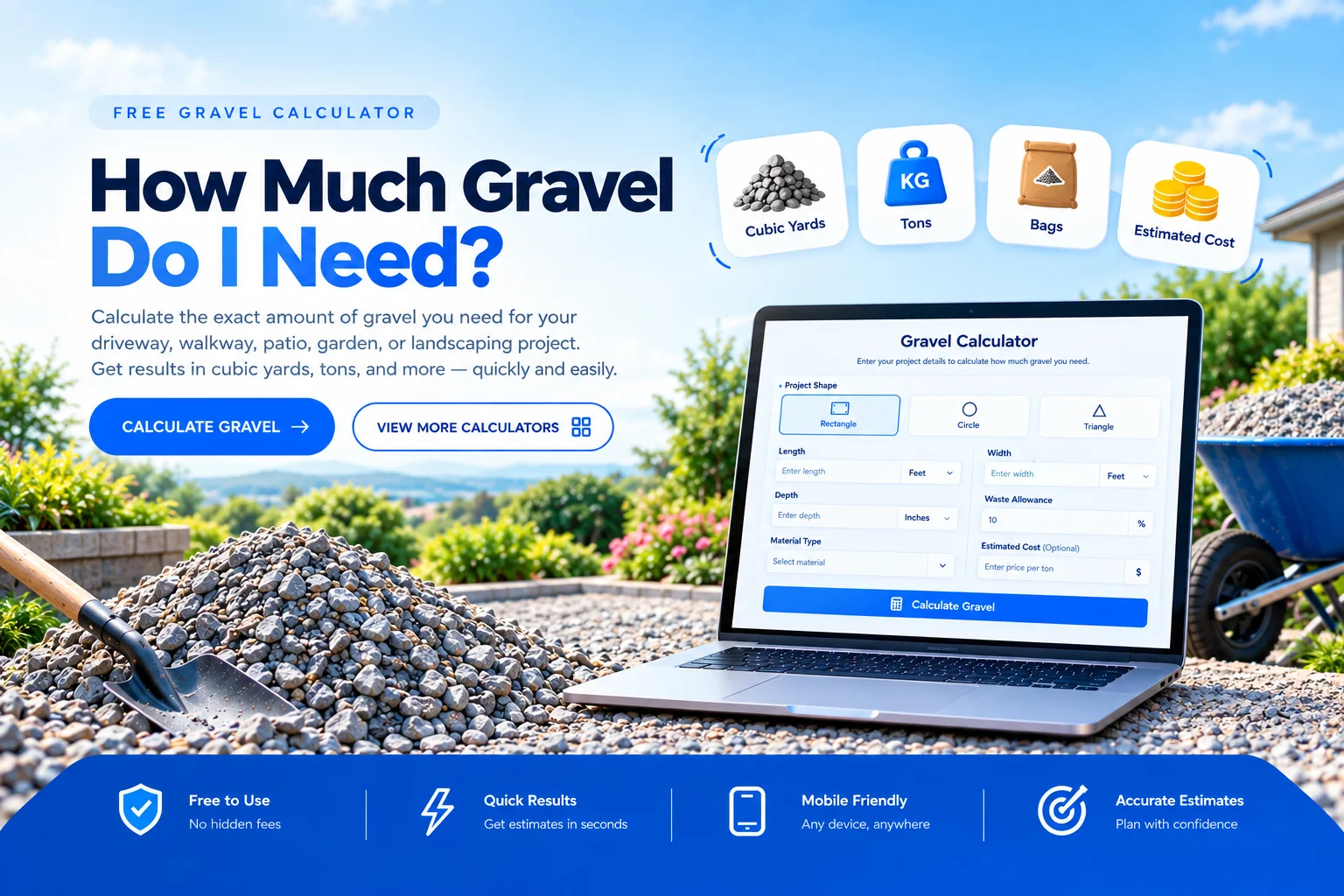
For a quick estimate, use the Gravel Calculator to calculate cubic yards, cubic feet, tons, pounds, bags, and estimated cost based on your project dimensions.
The important part is choosing a realistic depth before ordering. A decorative garden area, walking path, and vehicle driveway do not necessarily use the same gravel depth.
How Much Gravel Do I Need?
To calculate how much gravel you need, multiply the length by the width and depth of your project.
The basic formula is:
Cubic Feet = Length × Width × Depth
If your measurements are in feet, convert the final cubic feet to cubic yards:
Cubic Yards = Cubic Feet ÷ 27
If your depth is measured in inches, convert inches to feet first:
Depth in Feet = Depth in Inches ÷ 12
Then:
Cubic Yards = Length × Width × (Depth ÷ 12) ÷ 27
You can also combine the conversion into one shortcut:
Cubic Yards = Length × Width × Depth in Inches ÷ 324
For example, suppose you have an area that is:
- 20 feet long
- 10 feet wide
- 4 inches deep
The calculation is:
20 × 10 × 4 ÷ 324 = 2.47 cubic yards
So you would need approximately 2.47 cubic yards of gravel before allowing for additional material.
For a faster calculation, enter your measurements into the Gravel Calculator.
How Does a Gravel Calculator Work?
A gravel calculator takes the dimensions of your project and converts them into a useful material estimate.
Most calculators use:
- Length
- Width
- Depth
- Material type or density
- Optional waste allowance
- Optional material price
The result can be shown in several units, including:
- Cubic feet
- Cubic yards
- Cubic meters
- Tons
- Pounds
- Bags
- Estimated cost
The volume calculation is based on geometry. Weight is an estimate because gravel density varies depending on the type of stone, particle size, moisture, and how tightly the material is packed.
That’s why a calculator should be treated as a planning estimate, not an exact supplier quote.
How to Calculate Gravel in Cubic Yards
Bulk gravel is commonly ordered by the cubic yard, so cubic yards are one of the most useful measurements for larger projects.
The formula is:
Cubic Yards = Length × Width × Depth in Feet ÷ 27
Example: 10 × 20 Gravel Area
Imagine you’re covering a rectangular area measuring:
- Length: 20 feet
- Width: 10 feet
- Depth: 3 inches
First convert the depth:
3 ÷ 12 = 0.25 feet
Now calculate the volume:
20 × 10 × 0.25 = 50 cubic feet
Convert cubic feet to cubic yards:
50 ÷ 27 = 1.85 cubic yards
You would need approximately 1.85 cubic yards of gravel based on the calculated volume.
How to Calculate Gravel in Tons
Some gravel suppliers sell material by the ton instead of by the cubic yard.
The conversion from cubic yards to tons is not a single universal number because different gravel materials have different densities.
For planning purposes, many gravel calculators use an approximate density around 1.3–1.5 US tons per cubic yard, but the actual weight can vary. Current calculator references commonly use approximately 1.4 tons per cubic yard for typical gravel.
A simplified estimate is:
Tons = Cubic Yards × Estimated Tons per Cubic Yard
For example:
2.5 cubic yards × 1.4 tons = 3.5 tons
This is an estimate rather than a guaranteed delivery weight.
If you’re placing a large order, check the supplier’s stated density or tonnage conversion.
How Much Gravel Do I Need for a Driveway?
Driveways require more planning than decorative landscaping because vehicles place considerably more load on the surface.
There is no single driveway depth that applies to every property. Current guides commonly distinguish between the surface layer and the underlying base, with total depth depending on traffic, soil conditions, drainage, climate, and construction method.
A driveway may contain multiple layers rather than one uniform layer of decorative gravel.
For example, a project might include:
- A compacted base layer
- An intermediate aggregate layer
- A surface gravel layer
The exact construction should follow the requirements of the project and, where applicable, local construction guidance or supplier recommendations.
Example Driveway Calculation
Suppose a driveway is:
- 40 feet long
- 12 feet wide
- 6 inches of total gravel depth
Convert 6 inches to feet:
6 ÷ 12 = 0.5 feet
Calculate volume:
40 × 12 × 0.5 = 240 cubic feet
Convert to cubic yards:
240 ÷ 27 = 8.89 cubic yards
So the geometric volume is approximately 8.89 cubic yards.
If the driveway uses multiple layers, calculate each layer separately rather than automatically treating the entire structure as one type of gravel.
How Much Gravel Do I Need for a Walkway?
Walking paths generally use less material than driveways, but the correct depth depends on the type of gravel, the prepared base, soil conditions, edging, and intended use.
Current gravel guides commonly describe paths and decorative applications using relatively shallow layers, often around a few inches, while driveway structures can require considerably more material.
For example, suppose a walkway is:
- 30 feet long
- 4 feet wide
- 2 inches deep
Convert the depth:
2 ÷ 12 = 0.1667 feet
Calculate:
30 × 4 × 0.1667 ≈ 20 cubic feet
Convert:
20 ÷ 27 ≈ 0.74 cubic yards
So the calculated volume is approximately 0.74 cubic yards.
How Much Gravel Do I Need for Landscaping?
Decorative gravel is often used around:
- Flower beds
- Trees
- Garden borders
- Outdoor seating areas
- Walkways
- Ground cover
- Drainage areas
For decorative applications, depth is usually driven by the purpose of the layer, the size of the stone, the underlying surface, and whether the area has edging or landscape fabric.
Instead of choosing a depth simply because it is common online, check the installation recommendations for the specific gravel product you are buying.
Once you know the desired depth, the quantity calculation is straightforward:
Length × Width × Depth ÷ 27 = Cubic Yards
How Much Area Does One Cubic Yard of Gravel Cover?
One cubic yard contains:
27 cubic feet
But the amount of ground that one cubic yard covers depends entirely on the depth.
At a shallow depth, one cubic yard covers more square feet.
At a greater depth, the same cubic yard covers less area.
The relationship can be expressed as:
Coverage Area = Cubic Feet ÷ Depth in Feet
Since one cubic yard equals 27 cubic feet:
Coverage Area = 27 ÷ Depth in Feet
For example, at a depth of 3 inches:
3 inches = 0.25 feet
27 ÷ 0.25 = 108 square feet
So one cubic yard theoretically covers approximately 108 square feet at 3 inches deep.
At 4 inches:
4 ÷ 12 = 0.3333 feet
27 ÷ 0.3333 ≈ 81 square feet
Therefore, one cubic yard theoretically covers about 81 square feet at 4 inches deep.
These are geometric estimates. Real projects can require additional material because the ground is not perfectly level, gravel settles, and the finished surface may not have perfectly uniform depth.
Gravel Coverage Chart
Use this table as a quick mathematical reference for one cubic yard of material.
| Gravel Depth | Approximate Coverage per Cubic Yard |
|---|---|
| 1 inch | 324 sq. ft. |
| 2 inches | 162 sq. ft. |
| 3 inches | 108 sq. ft. |
| 4 inches | 81 sq. ft. |
| 5 inches | 64.8 sq. ft. |
| 6 inches | 54 sq. ft. |
| 8 inches | 40.5 sq. ft. |
| 10 inches | 32.4 sq. ft. |
| 12 inches | 27 sq. ft. |
These numbers come from the geometric relationship between 27 cubic feet and the selected depth. They do not account for compaction, uneven ground, or installation losses.
How Much Gravel Do I Need for a 10 × 10 Area?
A 10 × 10 foot area has:
10 × 10 = 100 square feet
The amount of gravel depends on depth.
At 2 inches deep
100 × 2 ÷ 324 = 0.62 cubic yards
At 3 inches deep
100 × 3 ÷ 324 = 0.93 cubic yards
At 4 inches deep
100 × 4 ÷ 324 = 1.23 cubic yards
At 6 inches deep
100 × 6 ÷ 324 = 1.85 cubic yards
This shows why depth is so important.
Changing the depth from 2 inches to 6 inches can nearly triple the amount of material required.
How Much Gravel Do I Need for a 10 × 20 Area?
A 10 × 20 foot area contains:
10 × 20 = 200 square feet
At 2 inches:
200 × 2 ÷ 324 = 1.23 cubic yards
At 3 inches:
200 × 3 ÷ 324 = 1.85 cubic yards
At 4 inches:
200 × 4 ÷ 324 = 2.47 cubic yards
At 6 inches:
200 × 6 ÷ 324 = 3.70 cubic yards
If your project is 10 × 20 feet, simply select the depth that matches your planned installation and use the corresponding result as the starting volume.
Should I Order Extra Gravel?
You may need more material than the exact geometric calculation suggests.
Real surfaces are rarely perfectly flat. Gravel can settle, move during installation, and fill small low areas. Compaction can also change the finished thickness depending on the material and construction method.
Some current gravel-calculator guides suggest allowances around 10%, while other project-specific guidance recommends different amounts.
Rather than automatically adding a fixed percentage to every project, consider:
- How level the existing ground is
- Whether the material will be compacted
- Whether you’re building a new base
- The type of gravel
- The depth tolerance
- How easy it is to order additional material
- Supplier minimum delivery quantities
For a simple decorative project, a modest allowance may be sufficient. A structural driveway or heavily compacted aggregate project may require a more detailed material estimate.
Gravel vs. Crushed Stone
The words “gravel” and “stone” are often used interchangeably in everyday conversation, but materials sold under those descriptions can have very different characteristics.
Depending on the product, you may encounter:
- Pea gravel
- River rock
- Crushed stone
- Crusher run
- Decorative gravel
- Landscape rock
- Washed stone
- Road base aggregate
The material affects drainage, compaction, appearance, stability, and weight.
That’s another reason not to rely on a generic tons-per-yard conversion when placing a large order.
Use the density supplied by the material supplier whenever it is available.
Common Gravel Calculation Mistakes
1. Forgetting to convert inches to feet
If your length and width are in feet but depth is entered as inches, don’t multiply the three numbers directly.
For example:
20 × 10 × 4
does not mean 800 cubic feet.
You must convert 4 inches to feet first.
4 ÷ 12 = 0.3333 feet
Then:
20 × 10 × 0.3333 ≈ 66.67 cubic feet
2. Dividing by the wrong number
One cubic yard equals 27 cubic feet, not 9.
Therefore:
Cubic Yards = Cubic Feet ÷ 27
3. Using the wrong depth
A one-inch difference across a large area can represent a significant amount of additional material.
Measure the intended finished depth carefully.
4. Treating all gravel as the same
Different aggregate products can have different densities and behavior.
Don’t assume that every type of gravel weighs exactly the same.
5. Confusing volume with weight
Cubic yards measure volume.
Tons measure weight.
The conversion between them depends on material density.
6. Ignoring multiple layers
A driveway or base project may contain different aggregate layers.
Don’t automatically multiply the entire driveway area by one depth if the project specification calls for separate layers.
What Information Do I Need Before Ordering Gravel?
Before contacting a supplier, collect:
1. Project length
Measure the longest dimension of the area.
2. Project width
Measure the width at several points if the area isn’t perfectly rectangular.
3. Desired depth
Determine the planned finished depth or the depth specified for your installation.
4. Material type
Know whether you’re ordering pea gravel, crushed stone, river rock, road base, or another product.
5. Estimated volume
Calculate cubic yards.
6. Estimated weight
If the supplier sells by the ton, calculate an approximate tonnage using the material’s stated density.
7. Delivery requirements
Ask about minimum order quantities, delivery fees, truck capacity, and whether the supplier sells partial cubic yards.
This information can make ordering much easier.
How to Calculate Gravel for an Irregular Area
Not every project is a perfect rectangle.
For an L-shaped area, divide the project into two or more rectangles.
Calculate each section separately:
Section 1 Volume + Section 2 Volume = Total Volume
For a triangular section:
Triangle Area = Base × Height ÷ 2
Then multiply the area by depth.
For a circular area:
Circle Area = π × Radius²
Then:
Volume = Area × Depth
Breaking a complicated project into simpler shapes is usually easier and less error-prone than trying to estimate the entire area as one shape.
Can I Calculate Gravel From Square Footage?
Yes.
If you already know the square footage, you only need the desired depth.
The formula is:
Cubic Yards = Square Feet × Depth in Inches ÷ 324
For example, a 500-square-foot area at 3 inches deep:
500 × 3 ÷ 324 = 4.63 cubic yards
So the geometric volume is approximately 4.63 cubic yards.
This is particularly useful when you already know the area from a previous measurement.
Use the BotCrumbs Gravel Calculator
Doing the calculation manually is useful for understanding the formula, but a calculator is faster when you’re working with a real project.
The BotCrumbs Gravel Calculator can help estimate:
- Cubic yards
- Cubic feet
- Tons
- Pounds
- 50-pound bags
- Estimated material cost
You can enter your project dimensions, select the shape, choose a gravel type, set the depth, and include a waste allowance.
For a quick estimate, use the Gravel Calculator before requesting a quote from your supplier.
Quick Gravel Calculation Formula
Keep these formulas handy:
Area:
Length × Width
Depth in feet:
Depth in inches ÷ 12
Cubic feet:
Length × Width × Depth in feet
Cubic yards:
Cubic feet ÷ 27
Shortcut when depth is in inches:
Length × Width × Depth ÷ 324
Estimated tons:
Cubic yards × material density
Remember that the final weight depends on the actual gravel product and its density.
Frequently Asked Questions
How much gravel do I need for a 10 × 10 area?
It depends on the depth. A 10 × 10 foot area needs approximately 0.62 cubic yards at 2 inches deep, 0.93 cubic yards at 3 inches, 1.23 cubic yards at 4 inches, and 1.85 cubic yards at 6 inches.
How many cubic yards of gravel do I need?
Calculate your length × width × depth and divide the result in cubic feet by 27. If depth is in inches, use:
Length × Width × Depth ÷ 324
How many tons of gravel do I need?
First calculate the cubic yards. Then multiply by the approximate tons-per-cubic-yard density for your specific material. Because density varies, use the supplier’s material specification when available.
How deep should gravel be?
There is no universal depth. Decorative areas, walkways, driveway surfaces, structural bases, and drainage projects can require different depths and construction methods. Current guides emphasize choosing depth based on the project’s purpose and conditions rather than using one number for every application.
How much area does one cubic yard of gravel cover?
It depends on depth. Mathematically, one cubic yard covers about 108 square feet at 3 inches deep, 81 square feet at 4 inches, and 54 square feet at 6 inches.
Should I buy extra gravel?
A small allowance can help account for uneven ground, settlement, movement, or installation losses. The appropriate allowance depends on the project and material, so don’t assume one percentage is correct for every situation.
Is a cubic yard the same as a ton?
No. A cubic yard measures volume, while a ton measures weight. The number of tons in a cubic yard depends on the density of the gravel.
Can I calculate gravel for a driveway?
Yes. Measure the driveway’s length, width, and planned depth, then calculate the volume. If the driveway has multiple aggregate layers, calculate each layer separately.
What is the easiest way to calculate gravel?
The easiest method is to use a gravel calculator. Enter your dimensions and depth to get the estimated volume, then use the material density to estimate weight when necessary.
Final Takeaway
The amount of gravel you need depends primarily on area and depth.
The core calculation is simple:
Length × Width × Depth ÷ 324 = Cubic Yards
when length and width are in feet and depth is in inches.
But getting the right order quantity involves more than the formula. You also need to consider the type of gravel, intended use, depth, multiple layers, compaction, ground conditions, and the supplier’s material specifications.
For a quick project estimate, use the BotCrumbs Gravel Calculator to calculate your required volume and estimated weight before contacting a gravel supplier.
For larger or structural projects, treat the calculator as a planning tool and confirm the final quantity and material specifications with your supplier or qualified professional.

Recent Posts
How Much Mulch Do I Need? Calculator, Coverage & Depth Guide

How Much Gravel Do I Need? Calculator, Depth & Coverage Guide