How Much Mulch Do I Need? Calculator, Coverage & Depth Guide
Planning a flower bed, garden, tree ring, playground area, or landscaping project? One of the first questions you need to answer is:
How much mulch do I need?
Buying too little can leave your project unfinished. Buying too much can mean extra cost, storage, and wasted material.
The good news is that calculating mulch is relatively simple once you know three measurements:
- Length
- Width
- Desired depth
From those measurements, you can calculate the amount of mulch required in cubic feet or cubic yards. If you’re buying bagged mulch, you can also convert the volume into an estimated number of bags.
For a quick estimate, use the BotCrumbs Mulch Calculator to calculate the amount of mulch needed for your project.
How Much Mulch Do I Need?
The amount of mulch you need depends primarily on the size of the area and the depth of mulch you want to install.
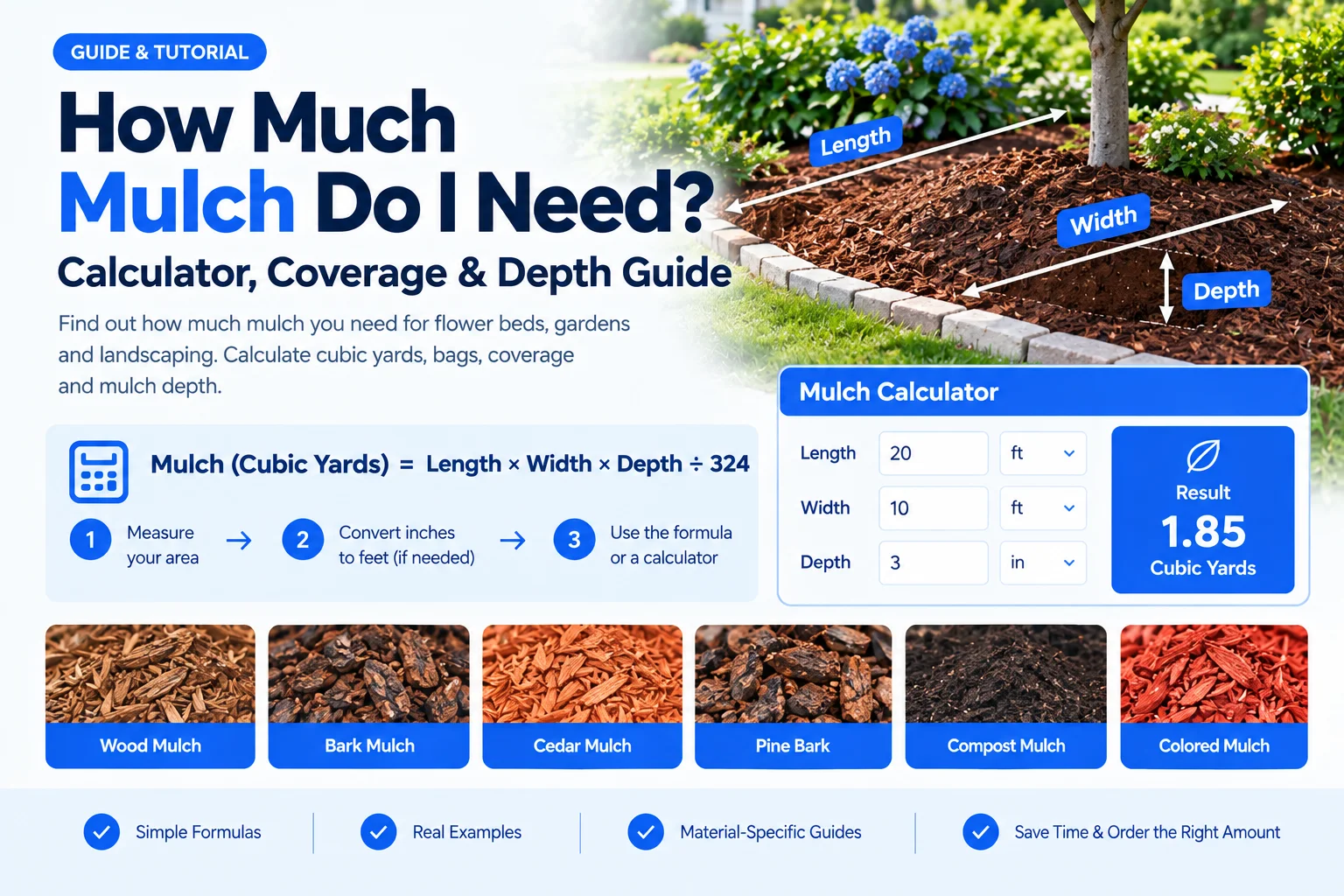
For a rectangular area, the basic formula is:
Cubic Feet = Length × Width × Depth
When length and width are measured in feet and depth is measured in feet, divide cubic feet by 27 to convert to cubic yards:
Cubic Yards = Cubic Feet ÷ 27
If your mulch depth is measured in inches, you can use this shortcut:
Cubic Yards = Length × Width × Depth in Inches ÷ 324
For example, suppose your flower bed is:
- 20 feet long
- 10 feet wide
- 3 inches deep
The calculation is:
20 × 10 × 3 ÷ 324 = 1.85 cubic yards
So the mathematical volume is approximately 1.85 cubic yards of mulch.
Use a Mulch Calculator
While the formula is simple, a calculator makes it easier to work with different areas, depths, units, and quantities.
The BotCrumbs Mulch Calculator can help you estimate the volume required for a landscaping project without having to perform the conversions manually.
Enter your measurements, choose the appropriate depth, and use the result to determine how much bulk or bagged mulch to purchase.
A calculator is especially useful when your project has several beds with different dimensions.
How to Calculate Mulch in Cubic Yards
Bulk mulch is commonly sold by the cubic yard, so cubic yards are one of the most useful units for larger landscaping projects.
The formula is:
Cubic Yards = Length × Width × Depth in Feet ÷ 27
If depth is in inches:
Cubic Yards = Length × Width × Depth in Inches ÷ 324
Example
Imagine a rectangular garden bed measuring:
- 30 feet long
- 8 feet wide
- 3 inches deep
Calculate the volume:
30 × 8 × 3 ÷ 324
= 2.22 cubic yards
You would therefore need approximately 2.22 cubic yards of mulch based on the calculated volume.
If your supplier sells mulch in whole or partial cubic yards, ask about their minimum order and delivery requirements.
How Deep Should Mulch Be?
There isn’t one depth that is perfect for every landscaping situation.
The appropriate depth depends on:
- Existing mulch
- Type of mulch
- Landscaping purpose
- Soil conditions
- Planting area
- Weed-control goals
- Whether you’re topping up an existing bed
Many landscaping projects use a few inches of mulch rather than a very thin dusting or an excessively deep layer.
For an existing bed, you may only need enough new mulch to restore the desired finished depth.
For a new bed, calculate the entire planned mulch layer.
Always follow the recommendations for the particular mulch product and plants in the area.
How Much Mulch Do I Need for a Flower Bed?
Flower beds are one of the most common places to use mulch.
Start by measuring:
Length × Width = Square Feet
Then multiply the square footage by the desired mulch depth.
For example, a flower bed measuring 12 × 20 feet has:
12 × 20 = 240 square feet
At 3 inches deep:
240 × 3 ÷ 324 = 2.22 cubic yards
At 4 inches deep:
240 × 4 ÷ 324 = 2.96 cubic yards
So increasing the depth by just one inch changes the quantity by approximately 0.74 cubic yards.
This is why measuring the planned depth before ordering is important.
How Much Mulch Do I Need for a 10 × 10 Area?
A 10 × 10 foot area contains:
10 × 10 = 100 square feet
Here’s the approximate volume at different depths:
| Mulch Depth | Mulch Needed |
|---|---|
| 1 inch | 0.31 cubic yards |
| 2 inches | 0.62 cubic yards |
| 3 inches | 0.93 cubic yards |
| 4 inches | 1.23 cubic yards |
| 5 inches | 1.54 cubic yards |
| 6 inches | 1.85 cubic yards |
These figures are mathematical volume estimates and don’t account for uneven ground, settlement, or other installation conditions.
How Much Mulch Do I Need for a 20 × 20 Area?
A 20 × 20 foot area has:
20 × 20 = 400 square feet
At 2 inches:
400 × 2 ÷ 324 = 2.47 cubic yards
At 3 inches:
400 × 3 ÷ 324 = 3.70 cubic yards
At 4 inches:
400 × 4 ÷ 324 = 4.94 cubic yards
At 6 inches:
400 × 6 ÷ 324 = 7.41 cubic yards
This illustrates an important point: mulch quantity increases directly with depth.
If you double the depth, you double the volume.
How Much Area Does One Cubic Yard of Mulch Cover?
One cubic yard contains:
27 cubic feet
The coverage depends on the depth of the mulch.
Mathematically:
Coverage Area = 27 ÷ Depth in Feet
For example, at 2 inches:
2 ÷ 12 = 0.1667 feet
27 ÷ 0.1667 ≈ 162 square feet
At 3 inches:
3 ÷ 12 = 0.25 feet
27 ÷ 0.25 = 108 square feet
At 4 inches:
4 ÷ 12 = 0.3333 feet
27 ÷ 0.3333 ≈ 81 square feet
Quick Coverage Reference
| Mulch Depth | Approximate Coverage per Cubic Yard |
|---|---|
| 1 inch | 324 sq. ft. |
| 2 inches | 162 sq. ft. |
| 3 inches | 108 sq. ft. |
| 4 inches | 81 sq. ft. |
| 5 inches | 64.8 sq. ft. |
| 6 inches | 54 sq. ft. |
These figures are based on pure volume calculations.
Actual coverage can vary because mulch may settle, compress, spread unevenly, or be applied over an irregular surface.
How Many Bags of Mulch Do I Need?
Bagged mulch is usually sold in a stated volume, such as 2 cubic feet per bag, although bag sizes vary by product.
To calculate the number of bags:
Number of Bags = Total Cubic Feet ÷ Cubic Feet per Bag
For example, suppose your project requires 50 cubic feet and each bag contains 2 cubic feet:
50 ÷ 2 = 25 bags
So you would need approximately 25 bags.
Always check the volume printed on the bag because not every mulch product uses the same bag size.
Example: 10 × 20 Area
Suppose you have a 10 × 20 foot area at 3 inches deep.
First calculate cubic yards:
10 × 20 × 3 ÷ 324 = 1.85 cubic yards
Convert cubic yards to cubic feet:
1.85 × 27 ≈ 50 cubic feet
If each bag contains 2 cubic feet:
50 ÷ 2 = 25 bags
Therefore, the project would require approximately 25 two-cubic-foot bags based on the calculated volume.
Bulk Mulch vs. Bagged Mulch
Choosing between bulk and bagged mulch depends on the size of the project, access, storage, delivery, and pricing.
Bagged mulch
Bagged mulch can be convenient for:
- Small flower beds
- Small garden projects
- Areas where a truck cannot easily deliver bulk material
- Projects where you want easy-to-handle individual quantities
The downside is that larger projects may require many bags.
Bulk mulch
Bulk mulch can make more sense for:
- Large flower beds
- Commercial landscaping
- Large garden areas
- Multiple planting beds
- Extensive ground coverage
Instead of counting individual bags, you normally order by cubic yard.
For larger projects, calculate the required cubic yards first and then compare the supplier’s bulk price with bagged alternatives.
How Much Mulch Do I Need Around Trees?
Tree rings are often circular or irregular rather than rectangular.
For a circular area, use:
Area = π × Radius²
Then multiply the area by the mulch depth.
Suppose the tree ring has a diameter of 8 feet.
Radius:
8 ÷ 2 = 4 feet
Area:
π × 4² ≈ 50.27 square feet
At 3 inches deep:
50.27 × 3 ÷ 324 ≈ 0.47 cubic yards
So the calculated volume is approximately 0.47 cubic yards.
For multiple trees, calculate each ring separately and add the volumes together.
Avoid placing mulch directly against the tree trunk. Follow appropriate tree-care guidance for the specific tree and landscape.
How to Calculate Mulch for an Irregular Garden
Some landscaping areas don’t have straight edges.
Instead of trying to calculate the entire area as one shape, divide it into smaller sections.
For example:
Area A + Area B + Area C = Total Area
If one section is rectangular and another is circular, calculate each one using its appropriate formula.
For a rectangle:
Area = Length × Width
For a triangle:
Area = Base × Height ÷ 2
For a circle:
Area = π × Radius²
After calculating the individual areas, add them together and multiply by the desired mulch depth.
This method is usually easier than trying to estimate an irregular shape as a perfect rectangle.
Should I Add Extra Mulch?
The mathematical calculation gives you the volume based on the dimensions you entered.
Real landscaping conditions can be different.
You may have:
- Uneven soil
- Low spots
- Sloped areas
- Existing mulch
- Settling
- Spillage
- Areas that require slightly more coverage
For this reason, some homeowners and landscapers choose to purchase a small amount above the calculated requirement.
The appropriate allowance depends on the project rather than one universal percentage.
For a small, level flower bed, the difference may be minor.
For a large or irregular landscape, a little extra can make it easier to finish the project without another delivery.
Common Mulch Calculation Mistakes
1. Forgetting to convert inches
If your length and width are in feet but depth is in inches, you must convert the depth correctly.
The shortcut is:
Length × Width × Depth in Inches ÷ 324
2. Using the wrong bag volume
A bag labeled 2 cubic feet is different from a bag containing 1.5 cubic feet.
Always check the actual volume printed on the package.
3. Measuring the wrong area
Don’t automatically measure the entire yard if mulch is only going into planting beds.
Measure the actual area that will receive mulch.
4. Ignoring existing mulch
If your bed already contains mulch, determine whether you’re topping it up or replacing it completely.
You may need considerably less material for a top-up.
5. Using one depth everywhere
A garden bed may not have a perfectly uniform surface.
Measure or estimate the planned finished depth realistically.
6. Confusing cubic yards with square feet
Square feet measure area.
Cubic yards measure volume.
You need both the area and depth to determine the amount of mulch required.
Can I Calculate Mulch From Square Footage?
Yes.
If you already know the square footage, use:
Cubic Yards = Square Feet × Depth in Inches ÷ 324
For example:
500 square feet × 3 inches ÷ 324
= 4.63 cubic yards
So a 500-square-foot area at 3 inches deep requires approximately 4.63 cubic yards of mulch.
How Much Does One Cubic Yard of Mulch Weigh?
Unlike gravel or stone, mulch can vary significantly in weight.
Factors include:
- Material type
- Moisture
- Particle size
- Age
- Wood species
- Compost content
For that reason, cubic yards are generally more useful than weight when estimating mulch volume.
If a supplier provides a weight per cubic yard for its particular product, use that figure rather than relying on a generic conversion.
How Much Mulch Do I Need for a Garden?
Start by determining the total area of the garden.
For a rectangular garden:
Length × Width = Square Feet
Then choose your desired depth and calculate:
Square Feet × Depth in Inches ÷ 324 = Cubic Yards
For example, a 15 × 25 foot garden is:
15 × 25 = 375 square feet
At 3 inches:
375 × 3 ÷ 324 = 3.47 cubic yards
At 4 inches:
375 × 4 ÷ 324 = 4.63 cubic yards
The deeper the mulch layer, the greater the volume required.
What Type of Mulch Should I Use?
The best mulch depends on the purpose of the landscape and the characteristics of the product.
Common options include:
- Hardwood mulch
- Cedar mulch
- Pine bark
- Wood chips
- Colored mulch
- Compost
- Straw
- Shredded bark
Consider:
- Appearance
- Longevity
- Availability
- Cost
- Moisture
- Local climate
- Plant requirements
- Maintenance
Your local landscape supplier can also tell you which products are commonly used in your area.
When Should I Replace Mulch?
Mulch doesn’t necessarily need to be completely removed every time.
In many situations, homeowners simply add new material to restore the desired depth.
However, the correct approach depends on the mulch type, existing condition, drainage, soil, plants, and landscape design.
Before adding a large quantity, inspect the existing layer and make sure you are not creating excessive depth around plants or structures.
Quick Mulch Calculation Formula
Keep these formulas handy:
Rectangular Area:
Length × Width
Depth in Feet:
Depth in Inches ÷ 12
Cubic Feet:
Length × Width × Depth in Feet
Cubic Yards:
Cubic Feet ÷ 27
Shortcut:
Length × Width × Depth in Inches ÷ 324
Bag Count:
Total Cubic Feet ÷ Bag Volume in Cubic Feet
These formulas work for straightforward rectangular areas. For circular or irregular beds, calculate the area using the appropriate geometric formula first.
Frequently Asked Questions
How much mulch do I need for a 10 × 10 area?
At 2 inches deep, a 10 × 10 foot area requires about 0.62 cubic yards. At 3 inches, it requires about 0.93 cubic yards, and at 4 inches, approximately 1.23 cubic yards.
How many bags of mulch do I need?
It depends on the size of each bag. Divide the total cubic feet required by the volume of one bag. For example, 50 cubic feet divided by 2 cubic feet per bag equals 25 bags.
How many cubic yards of mulch do I need?
Use:
Length × Width × Depth in Inches ÷ 324
for rectangular areas measured in feet and inches.
How much area does one cubic yard of mulch cover?
Approximately 162 square feet at 2 inches deep, 108 square feet at 3 inches, and 81 square feet at 4 inches.
How deep should mulch be?
The appropriate depth depends on the landscape, mulch type, existing material, plants, and purpose. Measure the desired finished depth rather than automatically using the same depth for every project.
Should I buy bagged or bulk mulch?
Bagged mulch can be convenient for smaller projects, while bulk mulch can be more practical for larger areas. Compare the volume and total price rather than comparing only the price of one bag.
Can I calculate mulch for a circular area?
Yes. Calculate the circular area using:
π × radius²
Then multiply the area by the desired depth.
Does mulch settle?
Mulch can settle and redistribute after installation. The amount of settling depends on the material, moisture, installation conditions, and environment.
Can I calculate mulch from square footage?
Yes. Use:
Square Feet × Depth in Inches ÷ 324 = Cubic Yards
This is one of the quickest methods when you already know the area.
Final Takeaway
Calculating mulch doesn’t have to be complicated.
You mainly need:
Length + Width + Depth
For a rectangular area, the shortcut is:
Cubic Yards = Length × Width × Depth in Inches ÷ 324
Once you know the cubic-yard requirement, you can compare bulk mulch prices or convert the volume into bags based on the size of the bag you’re buying.
For small projects, a few minutes of measuring can prevent you from buying significantly more or less material than you need.
For larger landscaping projects, calculate each area separately, consider the actual finished depth, and confirm the final quantity with your mulch supplier.
And if you want to skip the manual calculations, use the BotCrumbs Mulch Calculator to estimate the amount of mulch required for your project.

Recent Posts
How Much Mulch Do I Need? Calculator, Coverage & Depth Guide

How Much Gravel Do I Need? Calculator, Depth & Coverage Guide